
by Enrico Manieri - Henry62
Traducción al español - Traducido de la versión inglesa por Red crítica del 11-S con permiso del autor.
.
UPDATE - March 17th, 2008
.
.
***
Translated and adapted by Paolo Attivissimo with the author's permission.
The original Italian article is available in the author's 11-settembre blog.
***
Abstract: research into the causes of a conspicuous flow of glowing material from the corner of the 81st floor of the South Tower leads to the finding of evidence of a highly flammable UPS system at that location and suggests a possible triggering event for the flow and associated fire. Photographic evidence of floor failures is provided. Molten steel is ruled out as an ingredient of the flow.
***

On September 3, 2006, I took part in the second Speciale TG1 program on 9/11 mysteries broadcast by Italian national TV station Raiuno. During the program, the presenter, Roberto Olla, asked me what I thought of the incandescent material which was seen and taped as it flowed out of the 80th-81st floors of the north face of the South Tower of the World Trade Center (WTC2), shortly before the building collapsed. This is a well-known video, which many conspiracy theorists use as evidence that there was molten steel in the South Tower before it collapsed. The flowing material has not been identified beyond doubt. The prevailing expert opinion is that it was molten aluminum, not steel, mixed with other materials from the affected floor which came into contact with the molten or very hot metal. NIST clarified its opinion on this matter in the FAQ document it published in August 2006. Its conjecture is that the flow originated from a puddle of molten aluminum from the structure of the Boeing 767-200 that hit the Tower at the affected floor, with the addition of other materials, such as resins, plastics, glass from office furnishings and from the interior walls. As the floor trusses of the 81st and 80th floors failed and tilted, the puddle was provided with a path to flow outward. The failure of these floors is documented also by photographs taken from outside the building, which show the floor trusses assuming positions which differed greatly from their design configuration.

According to NIST, therefore, light alloyed material from the aircraft and from the building melted and pooled on the floor. This melting was allowed by the very high temperatures of the raging fire which affected the 80th and 81st floor near the north face of the tower. The material flowed probably from the 81st floor onto the 80th and then flowed outward from there, after entraining materials, such as calcium sulfate (gypsum) and plastics, which were abundantly present in the building.
.

.
My opinion on this subject is fairly straightforward: I don't think it is molten steel for the simple reason that this material flowed for several minutes from the same position, yet there were no signs of any melting of the supporting steel structure of the building face, which would have been in direct contact with this molten material. It is quite obvious that the steel structure of the face would have been affected if the temperature of the molten flow had been close to the melting point of steel (approximately 1500 °C) but it would have had no trouble withstanding a molten light alloy at 600-650 °C, even if it had been superheated to approximately 800 °C. .
Reinforcement work for UPS
In my answer during the TV program I mentioned that probably there were electric batteries on the 81st floor of the South Tower, but some pro-conspiracy sites ridiculed this conjecture. However, experience has taught me that sarcasm and irony are usually signs of lack of better arguments, so I gave no further thought to such comments. My conjecture was based on several facts. First of all, I had found that the final NIST report, NCSTAR1-1, specified the Port Authority (PANYNJ) rules for alterations to the supporting structure of the Twin Towers requested by tenants.
.

.
Since the flow affected specifically a set of clearly identified floors, I searched for reports of any alterations to the supporting structures of those floors and for information as to the identity of the tenant or tenants of the 81st floor, which might have triggered the flow of molten material. On page 136 of the same NIST report I found this table which mentioned United Parcel Service, better known as UPS, as a tenant of the 81st floor of the South Tower and, even more importantly, mentioned that reinforcement work of the floors in the so-called "two-way" part of the floor in 1991.
.

.
I also found this information on page 50 of the NCSTAR 1-1C report):
.

.
Of course I was quite intrigued by this, so I researched further. Why would United Parcel Service, better known as UPS and a very well-known brand in deliveries, have a depot at the 81st floor of the South Tower and go the length of an extremely expensive reinforcement of the floor structures? First of all I checked the meaning of "two-way" in this context. This drawing of the Twin Towers' floor plan, from page 30 of the NCSTAR 1-1 report, provided the answer:
.

.
It turned out that the "two-way" area was the very corner region where the flow had occurred. Having established this, the next step was to determine exactly what was located at that floor. Another table, on page 170 of the NCSTAR 1-1C report), provided this information:
.

.
In 1999, the tenant of the 81st floor of WTC2, Fuji Bank Limited, carried out further reinforcement work on the "two-way" area with the following reason:
"Documents reference adding reinforcement to existing two-way floor trusses to accommodate new UPS workspace. Documents do not specify the required amount of reinforcement due to the new superimposed loads"
This work was done by the LERA engineering firm, which had been responsible for the structural calculations for the construction of the Twin Towers. Table 13.2 on page 111 of the NCSTAR 1-1H report again summarizes the reinforcement work performed in several stages by Fuji Bank on multiple floors of WTC2, including the 81st floor and extending also to the 80th and 82nd floors.
.
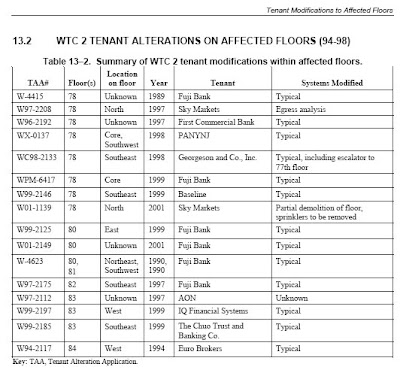
UPS vs UPS
Interestingly, in my opinion there is still an element of doubt, since this table, too, shows that the tenant was Fuji Bank: nothing to do with United Parcel Service. In the banking and IT sectors, "UPS" has a very specific meaning: Uninterruptible Power Supply. This is the name given to battery-based systems which must ensure the continuous supply of electric power for computer rooms and electrical medical devices which cannot tolerate the slightest power outage. Isn't it remarkable that the same floor, in the same "two-way" part of the South Tower, exactly where the mysterious flow occurred, was occupied by "UPS United Parcel Service" in 1991 (according to NIST) and by Fuji Bank Limited in 1999 (again according to NIST), and that Fuji Bank carried out reinforcement work "to accommodate new UPS workspace"? It may well be so, but my personal suspicion is that the acronym "UPS" was misinterpreted as referencing the international courier company but actually referred to one of Fuji's IT resources. Several sources confirm that data processing equipment related to the computer center was located on that floor: survivors have testified to this, and even pro-conspiracy sources (Christopher Bollyn, some months later) mention an unnamed "deep throat" who claims to have worked in this very facility. I'd like to point out that the Italian TV program was broadcast several months before these pro-conspiracy rumors circulated. For me, these rumors merely confirmed my initial conjecture, which was based on an analysis of official technical sources. So the 81st floor of the South Tower apparently had a large portion of its area occupied by the batteries of a UPS which belonged to Fuji Bank. However, this may seem irrelevant to many readers who are not familiar with UPS systems of medium-sized mainframe computers or data centers.
A visit to a UPS facility
In the 1990s I was involved professionally in this field, specifically in robotizing the management of electronic file tapes and in managing the UPS systems of a leading Italian banking group, so I am well acquainted with the safety problems and the physical and chemical characteristics of these batteries. To explain what a large UPS system looks like to those who are unfamiliar with these devices, I asked a banking service company for permission to take photographs of one of their battery rooms, which resembled the kind that might have been installed on the 81st floor of WTC2. It goes without saying that this is a particularly sensitive and delicate area of a service company, so I will comply with the company's request for anonymity. Access to this area is adequately protected by doors controlled by badge readers and both technological and security surveillance systems and by armed guards. Only maintenance personnel is normally allowed to enter.
.
.
The following photographs do NOT show WTC2.
..
They merely illustrate an example of the possible content of the floor in dispute and suggest a reason why two successive stages of floor truss reinforcement work were necessary in 1991 and 1999.
.

(The sign in Italian says "Battery Room - no smoking, no unauthorized access".)
.

.

.
The photographs clearly show that this kind of UPS consists of a huge number of lead batteries, each capable of supplying a nominal voltage of 2 V. The batteries are connected in series so as to provide a total of 440-480 V, as shown by the measurement instruments (shown below) located outside the battery room.
.

.
Providing 480 V with 2-V batteries requires 240 batteries connected in series to ensure that the electronic systems protected by the UPS are powered long enough to allow mains power to return or to start the Diesel generators.
.

.

.

.

.

.

.
The ventilation system requires particular care, since it must allow vigorous air changing: the batteries are composed of two electrodes formed by alternating plates of lead and lead dioxide immersed in an electrolyte (a sulfuric acid solution). They release toxic gases, and especially during quick charging and discharging processes, caused mostly by malfunctions, can release large amounts of hydrogen. This is a highly flammable gas which, combined with oxygen, could trigger violent explosive reactions, as some readers may recall from their college chemistry days.
.

.

.
For the same reason of possible presence of highly flammable gases, the electrical ventilation and lighting systems must be non-sparking, with cables and lamps which are isolated and sealed hermetically with respect to the battery room environment.
.

.

.
It goes almost without saying that the fire control system cannot use liquids. Halon systems are used instead, and this accordingly entails considerable safety problems for personnel who might be working inside the battery rooms when an emergency occurs. Large systems provide breathing bottles for personnel, providing enough air to reach escape routes. This is another reason why access to these areas is so restricted. Anyone entering must know exactly what procedure to follow in case of emergency. Certainly this is not a facility that can be visited during school trips.
.

.

.
It is particularly interesting to consider what might happen if a short-circuit affected such a battery system. The batteries are connected in series to each other and their cables are insulated by special plastic sheaths, as shown below.
.

.
A short-circuit of one or more batteries, caused for example by a falling metallic ceiling truss during a collapse, would trigger an electric arc which might have dramatic consequences due to the high currents involved.
In these videos from Youtube, we can see the thermal effects on a steel bar of high current (900 Amps and 700 Amps) and low voltage (2 Volts).
As reference for estimates, I consulted data on batteries manufactured by FAAM. Their physical and geometric characteristics are summarized in the following table.
.

.
This table shows that a single battery can weigh from 8 kg (for lower-capacity models with C10 = 100 Ah) to 111 kg (for batteries with C10 = 1500 Ah).
A battery like the ones shown below has a C10 of approximately 400 Ah and can be matched with the FAAM GFM-400 model, which weighs approximately 30 kg (European standards use C10, while American standards use C20).
.

.
The batteries show below have a C10 = 1340 Ah and therefore can be considered as equivalent to a model between FAAM GFM-1000 an GFM-1500, with an estimated weight of 80-90 kg each.
.

.
The short-circuit current that a single battery can deliver is provided by the following table.
.

.
This table shows that a battery with a C10 = 400 Ah releases, in case of a short circuit, 6816 amps, which rise well over 10,000 amps for batteries with a C10 = 1340 Ah. We're talking of currents with thousands of amps, which can produce unimaginable thermal effects. In addition to this, abundant hydrogen, which is highly flammable, is generated during a short circuit. A similar system was installed on the 81st floor of WTC2, exactly where the flow of molten material was observed.
.
Given these facts, it is very likely that the flow was due to light-alloy aluminum but also to the lead of the batteries, combined with other materials originating from the contents of the 81st floor. This combination of materials, after the failure of the floor, poured onto the 80th floor and from there flowed out from the building face. In my opinion, the weight of the batteries and the weakening caused by the fire on the 80th floor (which compromised the structural capacity of the overlying floor trusses) had an important role in the failure of the 81st floor.
.
--------------------------------------
. The author would like to thank
the IT service company that
allowed access and photographs
in one of their battery rooms.
--------------------------------------
.
.
NEWS FROM NIST!
.
After my article was published, I wrote to the NIST to ask information about the meaning of UPS.
On March 17, 2008, I received this email from Mr. Michael E. Newman, Spokesman, "NIST WTC Investigation":
.
 .
.
date: March 17, 2008 19:23
sender: Michael E. Newman
Re: Question about UPS in WTC2
Enrico,
modifications were made in 1991 to reinforce the 81st floor of WTC 2 in an area occupied by the United Parcel Service.
Modifications were made in 1999 to floor 81 in an area of the floor occupied by Fuji Bank to accommodate the weight of an uninterruptible power supply.
Both of these modifications are documented in the section of the NIST WTC Investigation Report known as NCSTAR 1-1C (go to http://wtc.nist.gov/NISTNCSTAR1-1C.pdf).
What is perhaps confusing is that both modifications were made to areas where there are two-way trusses (the corners of the building) and the acronyms (UPS for "United Parcel Service" and "uninterruptible power supply") are the same.
However, these modifications were made eight years apart for two different tenants, so there is no link between them.
I hope this answers your question. Thank you,
Michael Newman Spokesman, NIST WTC Investigation
. .
****************************************************************
Michael E. Newman - Senior Communications Officer Public Affairs Office - National Institute of Standards and Technology 100 Bureau Drive, Stop 1070 - Gaithersburg, MD 20899-1070
NIST info at
****************************************************************
.
I want to thank Mr. Newman and NIST for their clear and kind answer.
In my opinion it's the first time NIST clearly speaks about an UPS area in the 81st floor of WTC2, so my hypothesis is confirmed by NIST's WTC Investigation.
I think this is really a great result for a little Italian blog like "11-SETTEMBRE"!
See also:
.
=<>=


